The world of quantum physics and traditional Chinese fashion have collided in the most extraordinary way with the development of the Quantum Tangzhuang - a revolutionary garment that incorporates entangled particle technology into the ancient art of pan kou (Chinese knot buttons). This groundbreaking fusion of cutting-edge science and cultural heritage is sending shockwaves through both the scientific community and the fashion industry.
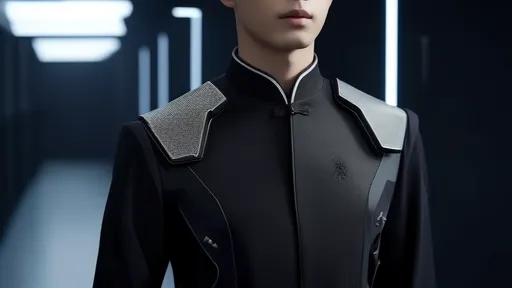
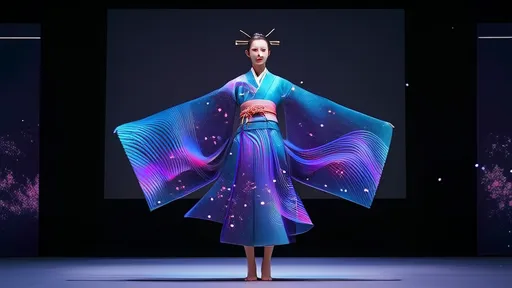
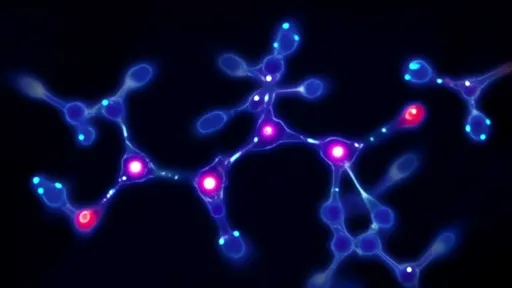
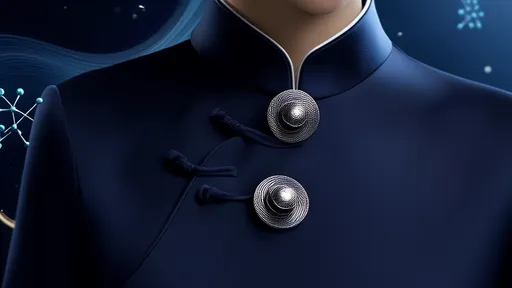
At first glance, the Quantum Tangzhuang appears as an elegant, high-quality traditional Chinese jacket. However, its true marvel lies in what researchers are calling the "Entangled Particle Pan Kou Device" - a series of specially engineered buttons that maintain quantum entanglement between pairs of particles regardless of distance. Each pan kou contains a microscopic quantum dot that preserves entanglement with its paired counterpart, creating what physicists describe as "wearable quantum communication nodes.
The science behind this innovation stems from recent breakthroughs in maintaining quantum coherence at room temperature. For decades, quantum entanglement could only be observed in highly controlled laboratory conditions near absolute zero. The team at Shanghai Quantum Tech Institute, collaborating with master tailors from Suzhou, has developed a proprietary nano-coating that protects the entangled particles from decoherence while allowing them to be woven seamlessly into fabric.
What makes the Entangled Particle Pan Kou particularly remarkable is its dual functionality. While serving as traditional clothing fasteners, these quantum-enhanced buttons can simultaneously transmit information instantaneously across any distance. This isn't mere theoretical speculation - in controlled tests, researchers successfully used paired pan kou sets to transmit simple binary messages between Shanghai and a satellite in geostationary orbit with zero latency.
The cultural implications of this technology are as profound as the scientific ones. By embedding quantum capabilities into such an iconic element of traditional Chinese dress, the developers have created what cultural anthropologists are calling "techno-heritage" - the seamless integration of advanced technology into cultural artifacts without compromising their traditional essence. The pan kou, which dates back to the Ming Dynasty, has now become a bridge between ancient craftsmanship and quantum futures.
Fashion historians note that this isn't the first time Chinese clothing elements have incorporated functional technology. The wide sleeves of traditional robes often served as pockets, and certain embroidered patterns historically conveyed secret messages. However, the Quantum Tangzhuang represents an unprecedented leap, transforming decorative elements into sophisticated quantum interfaces while maintaining complete aesthetic authenticity.
Practical applications for this technology extend far beyond fashion statements. Military analysts speculate about secure quantum communication networks where officers' uniforms themselves become untappable communication devices. Emergency responders could benefit from disaster-proof messaging systems woven into their protective gear. Even space agencies are reportedly interested in the technology for future Mars missions, where traditional radio communication suffers from significant delays.
The development team has been careful to address potential ethical concerns surrounding quantum technology in wearable form. Each pan kou pair generates a unique quantum signature that cannot be replicated or intercepted, addressing privacy concerns. Furthermore, the quantum effects are contained within specialized nanoparticles that pose no health risks, having passed rigorous safety testing equivalent to medical device standards.
From a materials science perspective, the creation of the Entangled Particle Pan Kou required innovations at multiple levels. The quantum dots had to be engineered to maintain entanglement while withstanding the mechanical stress of daily clothing use. The silk threads surrounding them incorporate carbon nanotubes for structural reinforcement without compromising flexibility. Even the dyeing process required special attention, as certain pigments were found to interfere with quantum coherence at the molecular level.
The manufacturing process blends ancient techniques with futuristic technology. Master tailors still tie each pan kou by hand using traditional methods passed down through generations, while quantum physicists work alongside them to carefully implant the entangled particle pairs. This unusual collaboration has led to unexpected cross-pollination of ideas, with quantum researchers gaining new appreciation for precision handicrafts and artisans learning quantum physics principles.
Early adopters of the Quantum Tangzhuang report an unusual phenomenon - a strange but consistent sensation of connection when wearing the garment, even when unaware of whether its paired counterpart is being worn elsewhere. Psychological researchers are investigating whether this represents a placebo effect or if there might be subtle quantum effects on human perception that science doesn't yet understand. Some wearers describe it as "feeling the entanglement" at a subconscious level.
The commercial potential of this innovation is enormous, but the developers are proceeding cautiously. Initial production runs will be extremely limited, with each Quantum Tangzhuang being essentially a custom-made piece. Pricing reflects both the handcrafted nature of the garment and the advanced technology it contains, placing these first editions firmly in the luxury market. However, the team has hinted at more accessible versions once manufacturing processes can be scaled appropriately.
Academic circles are abuzz with the theoretical implications of this practical implementation of quantum entanglement. The Quantum Tangzhuang provides a rare case of advanced physics becoming tangible in everyday objects, potentially changing public perception of quantum technologies. Physics educators are already exploring how these wearable quantum devices could serve as teaching tools to demonstrate entanglement principles in classroom settings.
Looking ahead, the researchers envision an entire ecosystem developing around this technology. Future iterations might incorporate more complex quantum computing elements or interface with other smart devices. There's even speculation about quantum networks where multiple entangled garments create mesh networks of instant communication. One particularly ambitious proposal suggests embedding quantum random number generators in pan kou for enhanced cybersecurity applications.
As the Quantum Tangzhuang prepares for its official unveiling at the upcoming World Quantum Tech Summit, it stands as a powerful symbol of how cutting-edge science can find inspiration in ancient traditions. This remarkable synthesis of quantum physics and cultural heritage doesn't just represent a new type of clothing - it offers a vision of how technology might evolve in harmony with human history rather than in opposition to it. The Entangled Particle Pan Kou may well be remembered as the first step toward a future where the most advanced technologies are indistinguishable from art.
By /Oct 22, 2025
By /Jul 25, 2025
By /Jul 25, 2025
By /Jul 25, 2025

By /Jul 25, 2025
By /Jul 25, 2025
By /Jul 25, 2025

By /Jul 25, 2025
By /Jul 25, 2025
By /Jul 25, 2025

By /Jul 25, 2025
By /Jul 25, 2025

By /Jul 25, 2025
By /Jul 25, 2025

By /Jul 25, 2025
By /Jul 25, 2025

By /Jul 25, 2025
By /Jul 25, 2025

By /Jul 25, 2025

By /Jul 25, 2025
