In the depths of our planet lies a mystery that has captivated scientists and dreamers alike—the Earth's core. Composed primarily of an iron-nickel alloy, this seething, molten heart powers our magnetic field and shapes the very ground beneath our feet. Now, a bold new venture in jewelry design seeks to bring a piece of that hidden world to the surface. By simulating the composition and aesthetic of core materials, artisans are crafting wearable pieces that echo the raw power and beauty of Earth's center.
The concept of translating geological phenomena into adornment isn’t entirely new, but the technical precision required to mimic the core’s unique alloy sets this endeavor apart. Traditional jewelry metals like gold and silver dominate the market, yet their origins pale in comparison to the cosmic journey of iron and nickel. These elements, forged in supernovae before coalescing into our planet, carry an astronomical legacy. Designers working with simulated core materials must balance scientific accuracy with artistic interpretation, often employing metallurgical techniques that mirror the extreme conditions found thousands of kilometers below the crust.
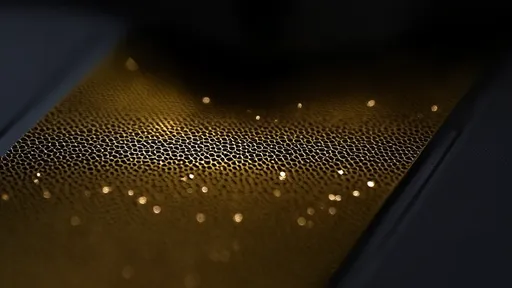
What does it take to recreate a substance typically subjected to pressures exceeding 300 gigapascals and temperatures rivaling the sun’s surface? Modern metallurgists start with ferro-nickel blends, adjusting ratios to match seismic data estimates of the core’s composition. Some incorporate trace elements like cobalt or carbon to enhance workability while preserving authenticity. The real challenge lies in replicating the visual texture—crystalline structures that would naturally form under immense depth. Through controlled cooling and specialized forging methods, craftsmen achieve surfaces that shimmer with the imagined luster of compressed metal at planetary scales.
The cultural resonance of core-inspired jewelry speaks to humanity’s enduring fascination with the unreachable. Just as Victorian explorers prized artifacts from distant lands, contemporary wearers of these pieces connect with the ultimate terra incognita—the interior of our own world. Some designs incorporate jagged, asymmetrical forms reminiscent of metallic crystals growing under pressure, while others polish the alloy to a mirror finish, reflecting the wearer’s face as if peering into the planet’s molten mirror. This duality between roughness and refinement becomes a metaphor for Earth itself—a sphere of violent geological processes wrapped in a thin, fragile crust of habitable calm.
Ethical considerations inevitably arise when dealing with materials symbolizing Earth’s depths. Unlike conflict minerals sourced through environmentally destructive mining, simulated core alloys offer a sustainable alternative. Their production requires no deep-earth extraction, instead relying on recycled metals and laboratory synthesis. This alignment with ecological consciousness appeals to consumers seeking meaningful luxury—jewelry that celebrates planetary wonders without exploiting them. Some collections even partner with geophysical research initiatives, donating portions of proceeds to fund core studies and seismic monitoring networks.
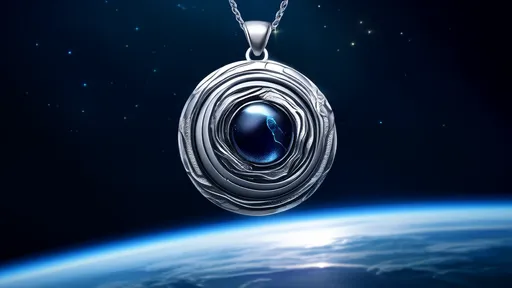
The emotional weight carried by these pieces transcends typical accessory narratives. A pendant forged from core simulation alloy becomes more than decoration; it’s a tangible connection to the forces that shaped human existence. The same metallic currents that generate our protective magnetic field, that allowed life to flourish by deflecting solar radiation, now take form as wearable art. This intersection of cosmology, geology, and craftsmanship creates objects dense with meaning—each gram containing eons of cosmic history and the promise of continued discovery as we probe deeper into our planet’s secrets.
As technology advances, so too does the fidelity of these geological recreations. Recent experiments with high-pressure anvils and diamond-tipped tools allow for ever more accurate simulations of deep-Earth conditions. The jewelry that emerges from these processes blurs the line between science and art, challenging our perception of value and rarity. In a world saturated with mass-produced ornaments, pieces born from humanity’s quest to understand its planetary home carry a different kind of prestige—one measured not in carats, but in kilometers of depth and degrees of celestial heat.
The movement toward geologically inspired design signals a broader shift in how we conceptualize luxury. Where once exclusivity derived from gemstone size or gold purity, now it springs from connection to planetary processes. Wearers become ambassadors of Earth’s hidden narrative, their jewelry sparking conversations about everything from plate tectonics to magnetic pole reversals. This educational dimension adds layers of significance absent from conventional fine jewelry, transforming each piece into a wearable lecture on planetary science.
Looking ahead, the potential for innovation in core-material jewelry seems as vast as the subterranean realms that inspire it. Researchers continue to refine their understanding of the core’s exact composition and behavior, with each discovery offering new creative possibilities. Some designers speculate about incorporating actual scientific equipment—fragments of diamond anvil cells used in core simulations, or alloys processed in gravity-manipulating centrifuges. Others imagine interactive pieces that respond to magnetic fields or temperature changes, creating living jewelry that mirrors the dynamic nature of Earth’s interior.
Ultimately, these creations serve as bridges between human scale and planetary immensity. They collapse the unimaginable distances separating us from the core into intimate objects that fit in the palm of a hand. In doing so, they fulfill an ancient human urge—to hold the untouchable, to wear the unknowable, and through that connection, better understand our place within the grand machinery of the Earth.
By /Oct 22, 2025

By /Jul 25, 2025
By /Jul 25, 2025

By /Jul 25, 2025

By /Jul 25, 2025
By /Jul 25, 2025
By /Jul 25, 2025

By /Jul 25, 2025
By /Jul 25, 2025

By /Jul 25, 2025
By /Jul 25, 2025
By /Jul 25, 2025

By /Jul 25, 2025
By /Jul 25, 2025
By /Jul 25, 2025

By /Jul 25, 2025

By /Jul 25, 2025

By /Jul 25, 2025
By /Jul 25, 2025

By /Jul 25, 2025
