As the final notes of the haunting guqin melody faded into the night air, the last model disappeared behind the crimson pillars of the Dacheng Hall, leaving behind a stunned audience that seemed to have traveled through time itself. The 2023 Nanjing International Fashion Week concluded last Sunday not with a whisper, but with a cultural earthquake that has reverberated through both fashion and heritage preservation circles worldwide.
Held within the sacred grounds of the Confucius Temple complex, this year's fashion week achieved what many had considered impossible: a genuine fusion of intangible cultural heritage with contemporary fashion that felt neither forced nor superficial. For five extraordinary days, ancient palace halls built during the Song Dynasty became living laboratories where six centuries of craftsmanship met tomorrow's design innovations.
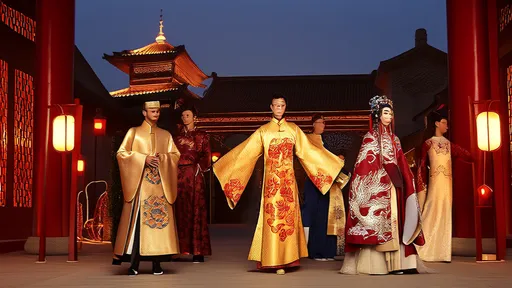
The venue itself became the first revelation. Dacheng Hall, traditionally reserved for ceremonies honoring the ancient sage, transformed into a runway where history and modernity engaged in continuous dialogue. The towering wooden beams, intricate carvings of dragons and phoenixes, and stone platforms that had witnessed imperial examinations now hosted a different kind of performance - one that celebrated both preservation and progression. Designers repeatedly mentioned how the space demanded respect, influencing their collections to speak in quieter, more profound visual languages.
What set this event apart was its deep scholarly approach to integration. Rather than simply printing traditional patterns onto modern silhouettes, designers embarked on months-long apprenticeships with master artisans. Yunjin brocade, once exclusively woven for imperial robes using techniques that produce gold and silver threaded patterns so complex that a day's work yields mere centimeters of fabric, found new life in structured blazers and evening gowns. The weight of the fabric, traditionally seen as a limitation, was reimagined as dramatic volume in skirts that moved like liquid metal.
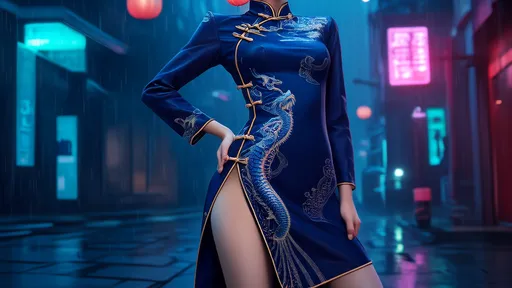
Meanwhile, Nanjing embroidery masters, whose ancestors created works for Ming Dynasty emperors, collaborated with designers to translate their symbolic motifs - clouds representing good fortune, bats for happiness, peonies for prosperity - into contemporary contexts. The result was breathtaking: a white cocktail dress featuring a single, sprawling embroidered dragon across the back, its scales catching light in ways that machine embroidery could never replicate.
The most talked-about collection came from emerging designer Zhang Wei, who spent six months studying with lacquerware artisans. "I wasn't interested in the finished objects," Zhang explained backstage, still visibly emotional after his show. "I became obsessed with the process - the layers upon layers of refinement, the acceptance of imperfections, the way time itself becomes a material." His collection featured garments treated with modified lacquer techniques, creating surfaces that changed texture and reflection depending on movement and light. The pieces literally evolved throughout the show, developing deeper patinas as models moved from backstage shadows into the hall's dramatic lighting.
International designers participating in the event approached the cultural elements with remarkable sensitivity. Italian designer Giovanni Moretti, known for his architectural silhouettes, created a series of pieces that incorporated traditional knotting techniques usually reserved for Chinese jade pendants. "The challenge," Moretti noted, "was honoring the technique without making it look like ethnic costume. We spent three months developing closures, seams, and structural elements that used the principles of the knots while serving entirely contemporary functions."
Beyond the visual spectacle, the fashion week hosted symposiums that brought together unlikely companions: fourth-generation craft masters and Silicon Valley tech innovators, museum curators and sustainable fashion advocates. The conversations revealed fascinating intersections, particularly around sustainability. The very slowness of traditional crafts - the days spent on a single embroidery, the years required to master gold-thread weaving - presented a powerful counter-narrative to fast fashion's breakneck pace.
Dr. Li Yan, director of the Nanjing Intangible Cultural Heritage Protection Center, observed that the event marked a significant shift in preservation efforts. "For years, we've been trying to save these crafts by documenting them or placing them in museums," she said. "What we witnessed this week was something different entirely - these traditions being needed again, being relevant to contemporary life. The young apprentices suddenly see possibilities beyond reproducing antique pieces."
The economic implications are equally promising. Several heritage workshops reported an unprecedented surge in orders during fashion week, with international buyers specifically requesting pieces that incorporated traditional elements. The Nanjing Yunjin Research Institute, which struggled to attract young weavers just two years ago, now has a waiting list of applicants wanting to learn the ancient craft.
Perhaps the most poignant moment came during the closing ceremony, when 78-year-old embroidery master Wang Shuxiang, whose hands have practiced her craft for sixty-four years, stood beside 24-year-old Central Saint Martins graduate Elena Petrova. They held hands as the audience gave a standing ovation that lasted seven minutes. There were no translators between them - none were needed. The language they shared was being worn by every model on the runway.
As the fashion world packs its garment bags and returns to the four fashion capitals, Nanjing has given it something to contemplate: that the future of fashion might not always be found in the new, but sometimes in the very old - waiting patiently in palace halls, in the hands of masters, in threads of gold that have outlasted dynasties. The殿宇秀场 (palace runway) has closed, but the conversation it started between past and future has only just begun.
By /Oct 22, 2025
By /Jul 25, 2025
By /Jul 25, 2025

By /Jul 25, 2025

By /Jul 25, 2025
By /Jul 25, 2025
By /Jul 25, 2025

By /Jul 25, 2025
By /Jul 25, 2025

By /Jul 25, 2025

By /Jul 25, 2025
By /Jul 25, 2025

By /Jul 25, 2025
By /Jul 25, 2025

By /Jul 25, 2025

By /Jul 25, 2025

By /Jul 25, 2025

By /Jul 25, 2025

By /Jul 25, 2025

By /Jul 25, 2025
