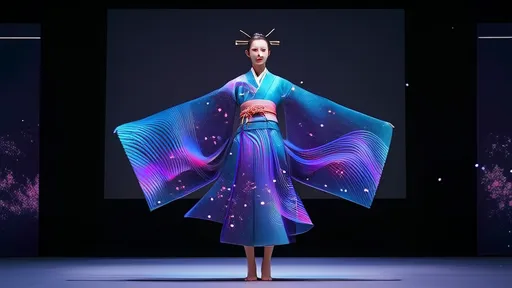
In a groundbreaking fusion of traditional craftsmanship and cutting-edge technology, researchers at Kyoto University have unveiled a prototype for "Digital Kimono: Electrochromic Furisode Projection Screen" – a wearable display system that transforms the iconic Japanese furisode (long-sleeved kimono) into an interactive canvas. This innovation marks the first successful integration of electroluminescent materials with traditional silk-weaving techniques, creating garments that change patterns and display dynamic visuals in response to environmental stimuli.
The project, led by Professor Haruka Shimoda from the Department of Advanced Material Science, began as an effort to preserve kimono culture among younger generations. "We're not replacing tradition," Shimoda emphasizes, "but creating a dialogue between Heian-period aesthetics and 22nd-century technology." The team collaborated with master weavers from Nishijin, Kyoto's historic textile district, to develop conductive silk threads capable of carrying electrical signals without compromising the fabric's drape or luster.
At the heart of this innovation lies a proprietary electrochromic layer sandwiched between translucent silk panels. When activated by microcurrents from hidden battery packs sewn into the obi sash, the molecular structure of specialized dyes shifts to reveal intricate patterns. The sleeves function as projection surfaces, with pico-projectors concealed in the kimono's collar casting animated motifs that interact with the wearer's movements, tracked by inertial measurement units (IMUs) woven into the garment's lining.
During demonstrations, the furisode displayed astonishing versatility. A single garment cycled through dozens of traditional patterns – from Edo-period yuzen dyeing to Art Deco geometrics – at the wearer's touch. More remarkably, the sleeves responded to atmospheric changes; humidity made cherry blossom designs bloom across the fabric, while temperature fluctuations caused color gradients to shift like sunset hues. The team achieved this through environmental sensors printed directly onto silk substrates using biocompatible metallic inks.
Cultural preservationists have praised the project's nuanced approach. Unlike previous attempts to modernize kimono that often sacrificed authenticity, this system maintains all traditional wearing protocols. The electronics are entirely removable, allowing the garment to be washed and maintained according to centuries-old methods. "It's like having a thousand kimonos in one," observes cultural anthropologist Dr. Kenjiro Matsuda, "yet it still requires the same knowledge of koshi-himo ties and ohashori folding as any proper furisode."
Technical challenges were formidable. The team spent eighteen months developing flexible circuitry that could withstand the kimono's constant motion without cracking. Their breakthrough came with spider silk-inspired conductive fibers that maintain connectivity even when stretched during formal movements like the hakobi (elegant walking style). Power consumption posed another hurdle, solved by piezoelectric elements in the hem that harvest energy from the wearer's steps – an innovation borrowed from Shinto shrine floorboards designed to creak like nightingales.
Fashion technologists predict wide-ranging applications. Beyond its obvious appeal for festivals and performances, the system could revolutionize accessibility. Visually impaired users could "feel" patterns through haptic feedback woven into the obi, while augmented reality integrations might project historical context about motifs in real-time. Early collaborations with Kyoto Geisha districts suggest potential for dynamic kaomise (seasonal performances), where a single kimono could transform to match multiple roles or seasons.
As with any disruptive technology, questions arise about cultural appropriation and commercialization. The research team has established strict guidelines: all production must involve certified kimono artisans, and designs must derive from historically significant patterns. "This isn't about making kimono into techwear," asserts master weaver Aiko Nakagawa, "but ensuring our great-grandchildren can appreciate komon stripes and asanoha patterns in an age of holograms." The project maintains an open-source database of traditional motifs to prevent misuse.
Looking ahead, the team plans miniaturization to adapt the technology for everyday komon (small-patterned kimono), with a consumer version projected for 2026. Meanwhile, the prototype will debut at December's Jidai Matsuri (Festival of Ages), where it will cycle through designs from each historical period represented in the parade. As Professor Shimoda watches her students practice their oharai (purification ritual) in glowing hakama, she reflects: "The past isn't static. True tradition has always embraced innovation – our ancestors would have used neon if they'd invented it."
This remarkable synthesis of heritage and hypertechnology suggests a future where cultural garments become living archives. As the electrochromic threads pulse like fireflies in Kyoto's twilight, they illuminate a path forward for traditional arts in the digital age – not as museum pieces, but as evolving conversations between memory and possibility. The digital kimono doesn't just display images; it weaves time itself into wearable form.

By /Oct 22, 2025

By /Jul 25, 2025
By /Jul 25, 2025

By /Jul 25, 2025

By /Jul 25, 2025
By /Jul 25, 2025

By /Jul 25, 2025

By /Jul 25, 2025

By /Jul 25, 2025

By /Jul 25, 2025

By /Jul 25, 2025
By /Jul 25, 2025

By /Jul 25, 2025
By /Jul 25, 2025

By /Jul 25, 2025

By /Jul 25, 2025

By /Jul 25, 2025

By /Jul 25, 2025

By /Jul 25, 2025

By /Jul 25, 2025
